
One of my clients’ garages had water damage after a big storm a few months ago. After repairing the roof leak, he wants to make further protection by stapling (brass staples to avoid rusting) sarking pieces from under the roof instead of removing tiles.
He found some products, such as Kingspan Air-Cell Insuliner and Trade Select by Ametalin ThermalBrane 4, and he wondered to cut them to size and stapled between the roof rafters from within the ceiling space. He thinks this sarking can give extra protection from leaks if the roof tiles have a crack in the future.
What’s Sarking, and what’s sarking used for?
Firstly, we need to know what’s the roof sarking, and what’s the functions of sarking used for on roof?
Collins Dictionary: Sarking is a timber or felt cladding placed over the rafters of a roof before the tiles or slates are fixed in place, especially in Scottish, Northern England and New Zealand.
According to Wikipedia, the definition and materials used for sarking vary significantly across the globe. For example, in the United States, wood panels (or sarking boards) are commonly referred to as sheathing, sheeting, or decking. They are installed under roof-covering materials like shingles to provide structural support. In modern Australian construction, sarking refers to a reflective foil laminate (RFL). This is a layer of laminated aluminium foil installed directly onto the roof trusses beneath the battens. It serves as a vital second skin for the home. This skin provides a radiant barrier for insulation and acts as a condensation barrier to protect the structure from moisture and heat.
In fact, the Australian National Construction Code (NCC) (2022) does not provide a single, broad definition for ‘sarking’. Instead, the NCC Glossary specifically defines ‘Sarking-type material‘ as a pliable building membrane or reflective foil laminate used for purposes such as waterproofing, vapour control, or thermal reflectance.
Based on the NCC definition, the sarking we use in Australia specifically refers to any pliable membrane or reflective foil laminate. Its primary functions are waterproofing, vapour control, and thermal reflectance, ensuring the home remains dry, breathable, and energy-efficient.
Where roof sarking is installed?
Sarking is installed externally during the construction or re-roofing phase. It is rolled out over the structural roof trusses (rafters) and pinned down before the timber roofing battens and final roof tiles or metal sheets are laid on top. Because it must sit underneath the timber support structure to shed water correctly, it cannot be fully installed from inside the ceiling manhole.
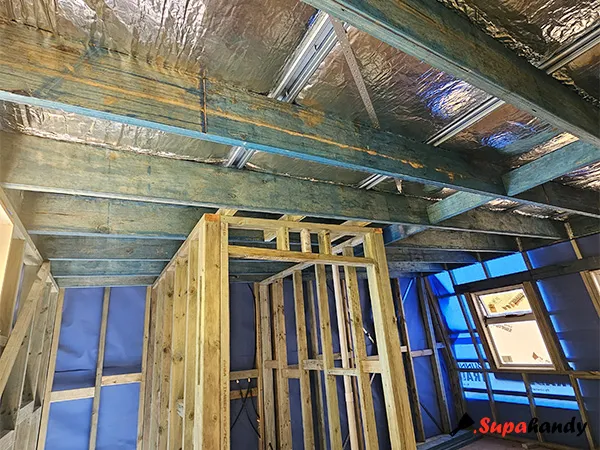
In Sydney, builders commonly use ‘blue’ colour sarking membranes to wrap external walls. For roofing, reflective foil laminates are the primary choice, as they provide an effective barrier against the intense Australian sun.
Why don’t some roofs have roof sarking protection?
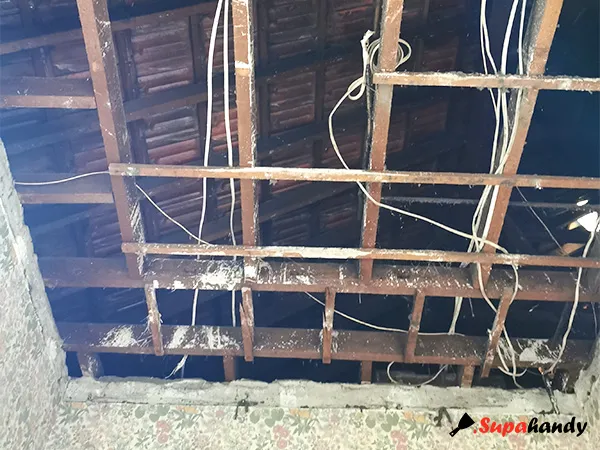
However, many properties—particularly older homes—lack roof sarking protection as it wasn’t a standard requirement in the past.
Even under NCC 2022, sarking is not universally mandatory for all roof types. However, it is strictly required for tiled roofs with specific pitch and length combinations, as well as for any home in bushfire-prone areas (BAL 12.5–FZ).
According to the National Construction Code (NCC) Part 3.5.1 (Roof Cladding), sarking is mandated for all new residential tiled roofs with a rafter length exceeding 6 metres. For rafters under 6 metres, the maximum allowable length without sarking is strictly determined by the roof pitch, as shown in the following table:
| Roof—degrees of pitch | Maximum rafter length without sarking (mm) |
|---|---|
| < 18 | 0 |
| ≥ 18 < 20 | 4500 |
| ≥ 20 < 22 | 5500 |
| ≥ 22 | 6000 |
Note: Rafter length is from the ridge to the fascia. Any tiled roof in a Bushfire Prone Area (BAL 12.5–FZ) requires sarking regardless of pitch or length.
Is sarking required for a Colorbond roof?
According to the National Construction Code (NCC), sarking is required for metal roofs only in some special cases:
- Bushfire Prone Areas (BAL 12.5–FZ): If your property is in a designated bushfire zone, sarking (often with a flammability index of ≤ 5) is mandatory to prevent ember entry.
- Thermal Breaks (Steel Frames): For houses with a steel-framed roof, specialised sarking (often called a thermal break) is required to stop heat from travelling through the metal.
Even when the law doesn’t require it, I recommend installing sarking under metal roofs to manage condensation. Metal roofs are prone to “sweating” as temperature changes. Without sarking, this condensation can drip onto your ceiling insulation, causing mould or timber rot.
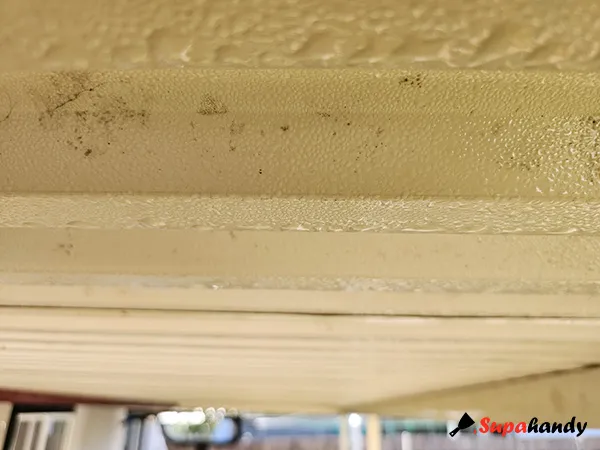
In Sydney, the most common time for a Colorbond roof to “sweat” is early winter morning as the sun rises. The rising temperature outside pushes moisture-laden air into the roof space, where it hits the metal sheets that are still freezing from the night before.
What’s the most important rule for roofing sarking?
The most critical rule for roofing sarking is that the upper layer of sarking must always overlap the lower layer.
According to NCC section 7.3.4:
- each adjoining sarking sheet or roll
- being overlapped not less than 150 mm;
- or taped together;
- and sarking fixed to supporting members at not more than 300 mm centres;
- and no sags more than 40 mm in the sarking.
Can we install foil sarking under the existing roof?
Okay, let us come back to my client’s question: Can we install foil sarking under the existing roof, instead of removing the roof sheet or roof tiles?
Yes, but it is not “true” sarking.
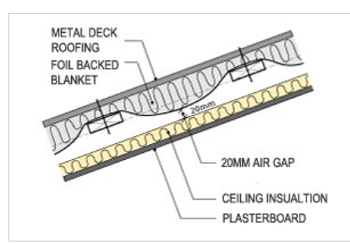
We can install foil insulation between the rafters from inside your roof space, while it cannot technically replace ‘sarking’ as defined by the NCC.
True sarking must be installed on top of the rafters and under the tiles or metal sheets to act as a drainage plane for water.
Retrofitting foil internally (under the rafters) can assist with reducing radiant heat flow; however, it provides relatively ineffective protection for the rafters themselves. Because the foil is under the timber, it cannot prevent roof leaks or condensation from reaching the rafters.
How many years can the sarking last?
While properly installed sarking can last a longer time, it is also not permanent.
After 40 or 50 years of enduring Sydney’s extreme roof temperatures, the material becomes brittle and ‘crisp’. In this state, it is in a punctured or torn state. And also, it lost its ability to protect your home from dust, moisture, and heat. If you see silver flakes or small pieces of blue plastic on the floor, it’s a sign your sarking is deteriorating.
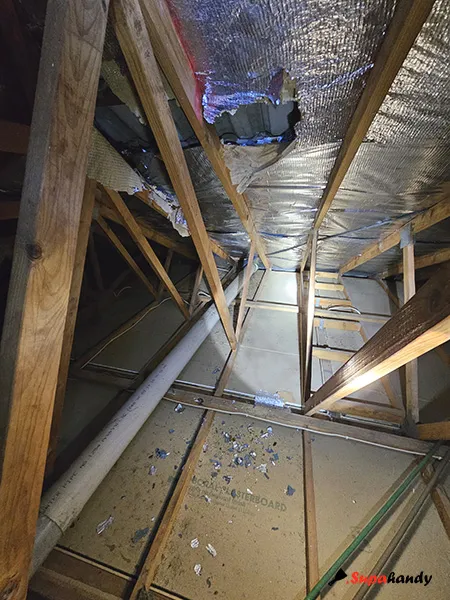
Electricians, solar installers, insulation installers, or pest controllers crawling through the roof cavity can accidentally slice, tear, or puncture the material. If tiles break or metal sheets lift, prolonged exposure to direct sunlight and intense heat will cause the polymer backing of the foil to turn brittle and flake away.
It’s better using your manhole to regularly check and repair minor sarking damage every few years. Catching minor rips early prevents small leaks from turning into major, expensive ceiling damage.
Can we DIY repair or replace damaged roof sarking?
As for minor tears or small punctures, high-quality foil tape can seal the cracks and maintain the barrier.
However, we do not recommend DIY repairs or replacement for the whole roof or the damaged section larger than a couple spans of rafter or batten.
Before laying down the new sarking—ensuring it is properly overlapped, taped, and tensioned—installers must integrate the following critical technical and safety principles into their installation strategy (more information referred to Australian Government’s YourHome Design Guide: Insulation):
- Reflective foil insulation must always face the warm side of the building system to function effectively. Like, in cold or temperate climates like Sydney or Melbourne, the reflective surface should face inward toward the living space to trap radiant heat. In hot, tropical zones, it must face outward to block radiant heat from penetrating the building fabric.
- Installers must maintain a minimum 25mm air space adjacent to the reflective, shiny side of the foil insulation. Because it only works by radiation and non-emittance, contact with any other building element will reduce its insulating properties to zero.
- Reflective foil insulation is a highly efficient electrical conductor. Installers must carefully evaluate the layout of all existing roof space, electrical wiring, solar conduits, and electrical fixtures.
How to replace roof sarking professionally?
Replacing roof sarking professionally is too hard from inside the manhole or roof cavity. Because sarking must sit underneath the timber battens and on top of the rafters to redirect water safely into the gutters, and a full or sectional external strip-down of the roof.
Even a professional roof team still need a couple of days’ plan to replace the whole property’s roof sarking.
They can replace one section of the roof (tiles or metal sheets) so that they can reasonably finish and re-cover this section of the roof within one day.
They start at the gutter (eaves) line and work up toward the ridge. Each new horizontal run of sarking must overlap the one below it by at least 150m. They lay the sarking with a slight sag (max 40mm) between rafters. This creates a valley for water to run down without touching the timber battens. Securing new sarking to the rafters using galvanised clouts or staples at 300mm centres.
All homeowners definitely want to replace their roof every single day. They don’t want their home exposed to the unpredictable weather for days.
Summary
I did some research into the NCC 2022 standards to gain a better understanding of roof sarking and cladding. And I share these essential rules alongside photos from my real-world projects to make them easier to understand. I hope more homeowners feel confident managing the common situations while improving their roof’s sarking and protection.
Got questions about your roof sarking or something I misunderstood or missed? Feel free to contact me anytime! I’m always happy to chat more about building standards and help you find the best solution for your home.